

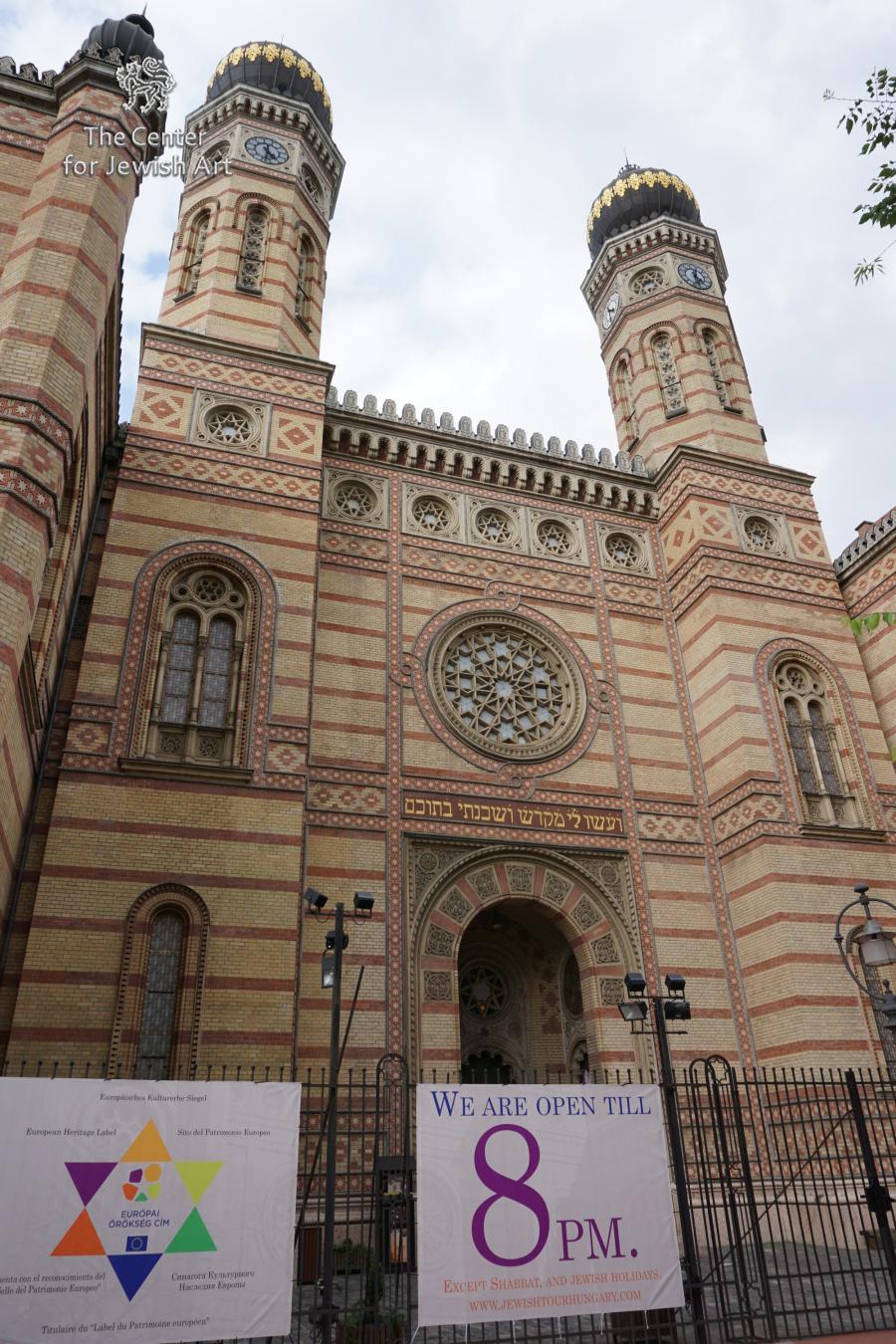
One of two earliest synagogues built in so-called Romantic Historicist style after the revolution of 1848 (cf. the Leopoldstadt Temple in Vienna, by the same architect, not existent). The tripartite scheme of the building alluded to the Solomonic Temple.
Gerõ, László, Magyarországi zsinagógák (Budapest, 1989);
Gazda, Anikó, Zsinagógák és Zsidó községek Magyarországon (Budapest, 1991);
Orbán, Ferenc, Magyarország Zsidó emlékei, nevezetességei (Budapest, 1991);
Rivka and Ben-Zion Dorfman, Synagogues without Jews and the Communities that Built and Used Them (Philadelphia, 2000), p. 329;
Kinga Frojimovics, Géza Komoróczy, Viktória Pusztai, Andres Strbik, Jewish Budapest: Monuments, Rites, History (Budapest, 1999), pp.105-113 with ills and plans, ills. on p. 127, 235-236, 288-289-293;
Rudolf Klein, The Great Synagogue of Budapest (Budapest, 2008);
Rudolf Klein, Zsinagógák Magyarországon, 1782–1918: Fejlődéstörténet, tipológia és jelentőség / Synagogues in Hungary, 1782–1918: Genealogy, Typology and Architectural Significance (Budapest: TERC, 2011), ill. 3.376-389, pp. 462-478;
Szegő, Dóra and György Szegő, Synagogues (Budapest, 2004), pp. 25-34.
http://search.cjh.org/primo-explore/fulldisplay?docid=cjh_digitool300510&context=L&vid=beta&lang=en_US&search_scope=CJH_SCOPE&adaptor=Local%20Search%20Engine&tab=default_tab&query=sub,exact,Synagogues,AND&mode=advanced&offset=0
https://jewish-heritage-europe.eu/2019/12/26/photo-essay-tracing-the-history-of-budapests-dohany-street-synagogue/