Home
Object Alone

Obj. ID: 11675
  Funerary Art
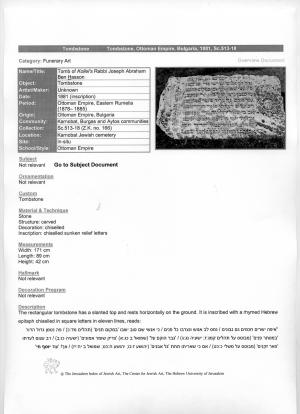
  Tomb of Rabbi Joseph Abraham Ben Hasson, Jewish Cemetery in Karnobat, 1881

© Center for Jewish Art, Photographer: Radovan, Zev, 1998

The rectangular tombstone has a slanted top and rests horizontally on the ground. It is inscribed with a rhymed Hebrew
epitaph chiselled in square letters in eleven lines, reads:

"איפה ישרים חכמים גם נבונים / נמס לב אנוש ונצרבו כל פנים / כי אנשי שם טוב ישבו 'במקום תנים' (תהלים מד:כ) / פה נטמן גדול הדור במסתר פנים' (מבוסס על תהלים קמג:ז; ישעיה נג:ג) / גבר הוקם על" (שמואל ב כג:א) צדיק שומר אמונים' (ישעיה כו:ב) / רב עצום לעדתו 'פאר זקנים' (מבוסס על משלי כוכט) / אם כי שאריתו תחת 'גל אבנים' (יהושע זכו; יהושע חוכט; שמואל ב יח:יז) / אך! עוד יוסף חי' (בראשית מה:כו) 'חסון הוא כאלונים' (עמוס ב:ט) / ה"ה (האדון המכובד) הרב הכולל כמוה'ר'ר (כבוד מורינו הרב רבי) יוסף / אברהם (ב)ן' חסון ז"ל (זכרונו לברכה) נ'ת'ב'ש'ם ('נתבקש בישיבה של מעלה' (בבלי, בבא מציעא, דף פו, ע"א); מת) יום ל' שבט / שנת ת'ר'מ'א' (641(5) ת'נ'צ'ב'ה' (תהי נשמתו צרורה בצרור החיים)."

Translation: "Where are the righteous persons, the wise men and clever?! A man's heart shall melt and all faces shall be burned (from the Lord's furnace), as men (who have) a 'good name' rest 'in the place of dragons' (Ps. 44:19; in the darkness of death). Here the outstanding Rabbi of the generation was buried (in a grave 'where the Lord) hid His face (from him)' (based on Ps. 143:7; Isa. 53:3). 'The man who was raised up on high' (2 Sam. 23:1), a 'righteous who keepeth the truth' (Isa. 26:2). A great Rabbi to his congregation, 'old men's glory' (based on Prov. 20:29), though his remnant is under 'a heap of stones' (Josh. 7:26; Josh. 8:29; 2 Sam. 18:17). Alas! 'Joseph is yet alive (Hai)' (Gen. 45:26), 'he is strong (Hasson) as the oaks' (Amos 2:9; see: Remarks: no. 1). (This is the burial tombstone of) the honourable master, the kollel's Rabbi, our honourable teacher, Rabbi Joseph Abraham Ben Hasson (son of Hasson), of blessed memory, who was summoned before divine justice (T.B. Baba Mezi'a 86:a; Euphemism: died) on the 30th of Shevat, (5)641 (30.1.1881 (Julian: 18.1.1881), may his soul be bound in the bond of life."

A scrolled medallion set on the right encloses illegible Hebrew letters.

Summary and Remarks

1. Joseph Hayyim Ben Hasson, emigrated from Salonika and served as the Chief Rabbi of Karnobat between the years 1840-1876. He composed a few Hebrew manuscripts that were never published (see: Jewish Encyclopedia, s.v. "Carnabat"). The name Hayyim, which signifies life and remedy, was likely added to his birth name, Joseph Abraham, after he suffered a severe illness, in the hope that it would be a turning point in his destiny. The practice is clearly indicated in the epitaph of Rabbi Hezekiah Zvi, who became severely ill and hence was renamed Hayyim (life) as well as Raphael (the angel of remedy) (Sc_513, 25). For a summary of this magi ceremony, see: Bar-Levav, "Death," p. 286.
2. The Julian calendar was used in Bulgaria until 1.4.1916, when the Gregorian calendar formally replaced it. Julian 1.4.1916 became Gregorian 14.4.1916.

Remarks

sub-set tree:  

Name/Title
Tomb of Rabbi Joseph Abraham Ben Hasson, Jewish Cemetery in Karnobat | Unknown
Object Detail
Monument Setting
Unknown
Date
1881
Active dates
Reconstruction dates
Artist/ Maker
Unknown
Origin
Historical Origin
Unknown
Community type
Site
Unknown
School/Style
Period Detail
Collection
Unknown |
Documentation / Research project
Unknown
11 image(s)    items per page

11 image(s)    items per page
Iconographical Subject
Unknown |
Textual Content
Unknown |
Languages of inscription
Unknown
Shape / Form
Unknown
Material / Technique
Material Stucture
Material Decoration
Material Bonding
Material Inscription
Material Additions
Material Cloth
Material Lining
Tesserae Arrangement
Density
Colors
Construction material
Measurements
Height
Length
Width
Depth
Circumference
Thickness
Diameter
Weight
Axis
Panel Measurements
Condition
Extant
Documented by CJA
Surveyed by CJA
Present Usage
Present Usage Details
Condition of Building Fabric
Architectural Significance type
Historical significance: Event/Period
Historical significance: Collective Memory/Folklore
Historical significance: Person
Architectural Significance: Style
Architectural Significance: Artistic Decoration
Urban significance
Significance Rating
0
Ornamentation
Custom
Contents
Codicology
Scribes
Script
Number of Lines
Ruling
Pricking
Quires
Catchwords
Hebrew Numeration
Blank Leaves
Direction/Location
Façade (main)
Endivances
Location of Torah Ark
Location of Apse
Location of Niche
Location of Reader's Desk
Location of Platform
Temp: Architecture Axis
Arrangement of Seats
Location of Women's Section
Direction Prayer
Direction Toward Jerusalem
Coin
Coin Series
Coin Ruler
Coin Year
Denomination
Signature
Colophon
Scribal Notes
Watermark
Hallmark
Group
Group
Group
Group
Group
Trade Mark
Binding
Decoration Program
Suggested Reconsdivuction
History/Provenance
Main Surveys & Excavations
Sources
Type
Documenter
|
Author of description
|
Architectural Drawings
|
Computer Reconstruction
|
Section Head
|
Language Editor
|
Donor
|
Negative/Photo. No.
The following information on this monument will be completed:
Unknown |