Obj. ID: 38466
  Memorials Memorial to the Martyrs of the Deportation, Paris, France, 1962
Name of Monument
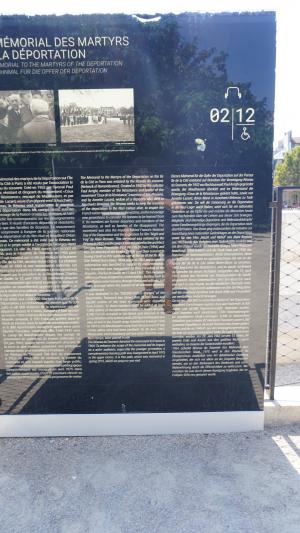
Mémorial des Martyrs de la Déportation
(Memorial to the Martyrs of the Deportation)
What/Who is commemorated?
200,000 people deported from France by the Vichy government
Description
The Mémorial des Martyrs de la Déportation (Deportation Memorial) is located at the eastern tip of the Île de la Cité in Paris. The memorial is shaped like a ship's prow; the crypt is accessible by two staircases and a lowered square protected by a metal portcullis. The crypt leads to a hexagonal rotunda that includes two chapel-like galleries containing earth and bones from concentration camps. The walls display literary excerpts from French authors.
[Cannaday] “The memorial immediately descends via a staircase composed of rough concrete walls and floors, to an asymmetrical open space.
Hornstein p. 313: “each step down creates a rhythm calculated in the architecture more time and perfect syncopation with what happens before our eyes: our careful movement down a very steep and narrow staircase with unusually high risers is calculated to progressively cancel the Parisian facades until they disappear altogether and all that is left for us to view is the geometrically square tiled white floor enveloped by the whitewashed solid walls of this empty and pinned, somewhat triangular, space. The striking austerity is relieved by a sculptural grille that leads the eye to the tip of the space, which is sliced off and left open with a view of the sand river, reminding us that we are level with the water.” 13 3/13
[Cannaday] Facing the Seine River, there are seven spear-like, abstract metal art pieces adorned with triangles. The floor of the open space is laid with stone tiles, which lead to the underground portion of the monument. The prison-like feeling continues into the passage.
Roughly dimpled concrete walls cover the corridor, with different dimple patterns on either side. Inside, a domed space is dimly lit by a memorial flame and centered on the metallic floor. Three separate wings break off from the hexagonal, domed room and lead to a tunneled crypt, and two disconnected, confined spaces.
Hornstein p. 315: “the final space is an internal, crypt-like interior space, again accessed by an acutely constricting pair of pylons. Natural light is limited, and artificial light is strategic. A hexagonal space is the site of a tomb of an unknown deportee. A very long and narrow corridor inaccessible to visitors--almost like a crawl space--exhibits 200,000 lighted glass beads on the facing walls. This may refer to the custom in Jewish synagogues of placing a light on the memorial board in memory of deceased relatives.
Across the entrance and above, etched deeply into the stone, is the inscription in French: “Two hundred thousand French citizens lost, exterminated in the Nazi death camps.”
Two galleries traverse the central space. They have low, triangular stone ceilings. The names of concentration camps color encircle the perimeter engraved on triangular copper plaques with red letters embedded deep in the concrete to mark the triangular urns with contain soil and ashes of concentration camp victims that are placed within.
Both ends of the chamber have small empty gated rooms that seem to depict prison cells. The walls outside of each cell are engraved with poems and texts from famous French writers Louis Aragon, French poet and French Resistance member Robert Desnos, Paul Éluard, Antoine de Saint-Exupéry, and Jean-Paul Sartre.
The enclosed crypt is adorned with triangular recesses and glistening beads. Its floor is laid with earth. The slate ceiling and walls reflect the sparkling glass fragments, symbolizing the lives of those who perished. Within the barred crypt lay the ashes of an unknown deportee from Natzweiler-Struthof, a concentration camp in the Alsace region of France.
Fragments of two poems by Desnos, who was a deportee, are inscribed on the walls. The first consists of the last stanza of a poem written pseudonymously by Desnos and published "underground" in Paris, on Bastille Day 1942, "The Heart that Hated War":
At the exit to the chamber is the injunction, engraved, found at all sites memorializing the victims of the Nazis: "Forgive but never forget."
Inscriptions
Inscription over the entrance, seen from the interior, in French:
PARDONNE, N'OUBLIE PAS
Translation: Forgive and don't forget
Inscription over the doorway, in French:
AURIGNY GROSS-ROSEN
BERGEN-BELSEN DORA-
ELLRICH REVENSBRUCK
DACHAU ORANIENBURG-
SACHSENHAUSEN
Around the walls of the hexagonal chamber, in French:
POUR QUE VIVE LE SOUVENIR DES DEUX CENT MILLE FRANCAIS SOMBRES DANS LA NUIT ET LE BROUILLARD EXTERMINES DANS LES CAMPS NAZIS
Translation: "Dedicated to the living memory of the 200,000 French deportees sleeping in the night and the fog, exterminated in the Nazi concentration camps."
Circular plaque on the floor of the underground chamber, in French:
ILS ALLÈRENT À L'AUTRE BOUT DE LA TERRE ET ILS N'E SONT JAMAIS REVENUS
Translation: "They descended into the mouth of the earth and they did not return."
Inscription on wall, in French:
CELUI QUI CROYAIT
AU CIEL CELUI QUI
N'Y CROYAIT PAS
TOUS LES DEUX
AIMAIENT LA BELLE
PRISONNIÈRE
DES SOLDATS
ARAGON
Translation: The one who believed in heaven the one who did not believe in it both loved the beautiful prisoner of the soldiers.
Inscription on wall, in French:
- ET LE CHOIX
QUE CHACUN FAIT
DE SA VIE ET DE
LUI – MEME ETAIT
AUTHENTIQUE
PUISOU’IL SE
FAISAIT – EN
PRESENCE DE LA
- MORT –
SARTRE
Translation: And the choices that each one made of their life and themselves was authentic since it was done in the presence of death - Sartre
Inscription on wall, in French:
JE N’EST PAS
DE COMMUNE
MESURE ENTRE
LE COMBAT
LIBRE ET
L’ECRASEMENT
DANS LE NUIT
ST EXUPERY
Translation: I have no common measure between free combat and destruction in the night
Inscription on wall, in French:
JE SUIS NE POUR TE CONNAITRE
POUR TE CHANTER LIBERTE
PAUL ELUARD
MAIS LE JOUR OÙ LES PEUPLES
AURONT COMPRIS QUE VOUS ÉTIEZ,
ILS MORDRONT LA TERRE DE CHAGRIN
ET DE REMORDS. ILS L'ARROSERONT
DE LEURS LARMES ET ILS VOUS
ÉLÈVERONT DES TEMPLES.
VERCORS.
Translation: I was born to know you and to sing to you. / Paul Eluard / But the day when people have understood who you were, they will bite the earth with sorrow and remorse; they will water it with their tears, and they will raise temples for you. / Vercors
Inscription on wall, in French:
J’AI REVE TELLEMENT FORT
DE TOI – J’AI TELLEMENT
MARCHE TELLEMENT PARLE
TELLEMENT AIME TON OMBRE
OU’IL NE ME RESTE PLUS
RIEN DE TOI – IL ME RESTE
D’ETRE L’OMBRE ENTRE LES
OMBRES L’OMBRE QUI VIENDRA
ET REVIENDRA DANS TA VIE
ENSOLEILLE. R. DESNOS
Translation: I dreamed so strongly of you, I walked so much, spoken so much, loved your shadow so much, where I have nothing left of you. I have left to be the shadow among the shadows, the shadow that will come and come again back into your sunny life.
Inscription on wall, in French:
CAR LES COEURS QUI
HAISSAIENT LA GUERRE
BATTAIENT POUR LA
LIBERTE AU RYTHME
MEME DES SAISONS ET
DES MAREES DU JOUR
ET DE LA NUIT
R. DESNOS
Translation: For hearts that hate war beat for freedom to the very rhythm of the seasons and the tides of day and night.
Commissioned by
Réseau du Souvenir and presented to the Government of France
Maintained by Bureau des monuments historiques et des lieux de mémoire (at Ministry of Defense)
sub-set tree: 
The Memorial is dedicated to the 200,000 people who were deported from France to Nazi concentration camps during the Second World War. It was dedicated by French President Charles de Gaulle in 1962. The monument was expanded in 1975 and again in 2016 with upper rooms the display historical information.
“The idea for the memorial was promoted in 1953 by the Réseau de Souvenir [Network of Remembrance], which had been founded the previous year as an association of survivors of the German concentration camps. The Réseau pushed for the passage of the law of 14 April 1954 which designated the last Sunday in April to be dedicated to victims of the deportation and survivors of the death camps. The Réseau also requested that the municipal council of Paris obtain an appropriate site for a memorial. The project was authorized to proceed (the council unanimously voted in favor of building a monument to the martyrs of the deportation on Parisian soil), but the site was not officially designated until 1956, when the Municipal Council allocated a lot “on the point of the Île de la Cité, upriver of the Seine, in the Archbishop’s Square.” Still, the process was slow. In 1958, the Ministry of the Interior authorized the building of the memorial, but in December 1960 the Prime Minister launched a public campaign for the creation of a national committee for the building of a monument in Paris to the memory of the heroes and martyrs of the deportation, this was followed by followed by an order from the ministry of war veterans. The project was finally realized and inaugurated in 1962 by President Charles de Gaulle.
The memorial's entrance is narrow, marked by two concrete blocks. Architect Pingusson intended that the memorial’s long narrow subterranean space convey a feeling of claustrophobia. Inside is the tomb of an unknown deportee who was killed at the camp in Neustadt. Along both walls of the narrow, dimly lit chamber are 200,000 glass crystals with light shining through, meant to symbolize each of the deportees who died in the concentration camps; at the end of the tunnel is a single bright light.
Pingusson created several symbolic design elements—narrow passages, tight staircases, spiked gates, restricted views with no sight horizon, and triangular shapes all meant to recall the confinement and oppression of concentration camps. These elements give a feeling of no escape.
In its final form the monument is silent on the group identities of the commemorated victims or about the circumstances of their deportation and death. There is no explicit mention of Jews as a group particularly singled out, and as the largest group of deportees. There are no specifically Jewish references in the chosen texts or symbols. In earlier designs for the monument, however, this was not the case. Hornstein (p. 3190 writes that:
“earlier sketches of the memorial clearly indicate direct references to the Jewish losses. In these images, Pingusson inscribes the Star of David as a central symbol placed on the flat surface of the upper frame of the memorial and at the entrance to it. Yet the actual memorial, and the final phases of the drawings, no longer contain the image. It disappears without an archival trace and it can only be assumed from this that there was no desire to recognize Jewish losses but that over time, it was decided to eliminate any references to those losses. How curious it is, then, and almost destined, that some interpretations of the monument are convinced of its Jewish references.”
Hornstein writes that “the memorial…” never utters a syllable to recognize the cultural identities of those murdered or, furthermore, to acknowledge that the overwhelming majority of lives lost by deportation to death camps during the Second World War were Jewish. Instead, this memorial in this topographical site read as a stunning erasure of Jewish presence and Jewish identity, and in the end an erasure of any Jewish topography of France, while highlighting French national martyrdom.”
Designated a National Historic Monument (monuments historiques) in 2007.
Amsellem, Patrick, "Memory, Myth, and the Politics of Commemoration: Inauguration" in Remembering the Past, Constructing the Future. The Memorial to the Deportation in Paris and Experimental Commemoration After the Second World War, 2007, p. 34.
Brochard, Antoine, Mémorial des martyrs de la déportation: Histoire d'une construction mémorielle (Paris: Éditions du Linteau, 2015)
Cannady, Lauren, "Under the Shadows of the Eiffel Tower: Holocaust Souvenirs of Paris," (College of Charleston, 2012), pp. 14-16., https://media.clemson.edu/caah/pdp/hp/holocaust_souvenirs_of_paris.pdf (accessed December 23, 2024)
Cassou, Jean, “War Memorial, Paris: A Monument to the French victims of Nazi concentration Camps,” Architectural Review 133 (March 1963), 186-190.
Dautremer, Marguerite Silve, “À Paris, les visiteurs sont de plus en plus nombreux au Mémorial des martyrs de la Déportation,” Ministère des Armées, August 22, 2023., https://www.defense.gouv.fr/sga/actualites/paris-visiteurs-sont-plus-plus-nombreux-au-memorial-martyrs-deportation (accessed December 23, 2024)
Hornstein, Shelley, "Memorializing Site: On the Grounds of History," Losing Site: Architecture, Memory and Place, (Burlington, Farnham: Ashgate Publishing, 2011), pp. 27-28., https://books.google.co.il/books?id=MQLRpUYwSWwC&pg=PA27&redir_esc=y#v=onepage&q&f=false (accessed December 23, 2024)
Richards, Kieran, “Collective Memory and Deported Truths: Interpretations of a Parisian Memorial,” Academia.edu, https://www.academia.edu/40494561/Collective_Memory_and_Deported_Truths_Interpretations_of_a_Parisian_Memorial (accessed December 23, 2024)
van Parys, Johan, "Memorial des Martyrs de la Deportation (Paris)," EnVisionChurch, 2007., https://web.archive.org/web/20140327234421/http:/www1.georgetown.edu/centers/liturgy/envisionchurch/33549.html (accessed December 23, 2024)
Vitou, Elizabeth, “Paris, Mémorial de la Déportation: Georges-Henri Pingusson (1894-1978),” Architecture Mouvement Continuité, no. 19, February 9, 1988., pp. 66-68.
Wiedmer, Caroline, The Claims of Memory: Representations of the Holocaust in Contemporary Germany and France (Ithaca, NY and London: Cornell University Press, 1999)
Winstone, Martin, The Holocaust Sites of Europe: An Historical Guide (London & New York: I. B. Taurus, 2010)., p. 13.
“Christine Albanel annonce le classement au titre des monuments historiques du mémorial des Martyrs de la Déportation, situé à Paris 4e, sur l'Ile de la Cité," Discours et Communique, December 14, 2007., http://www2.culture.gouv.fr/culture/actualites/communiq/albanel/memorial07.htm (accessed December 23, 2024)
“Mémorial des Martyrs de la Déportation,”
Wikipedia, https://en.wikipedia.org/wiki/Mémorial_des_Martyrs_de_la_Déportation.